
As seen in Toyota Trails!
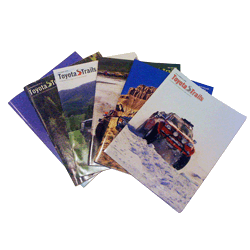
Various articles written here have been published in TLCA's Toyota Trails magazine and on their website. After roaming around our site, click on the magazines to visit TLCA.
Land Cruiser Info
Body and Frame Swap
By Tony K
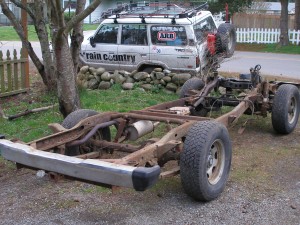
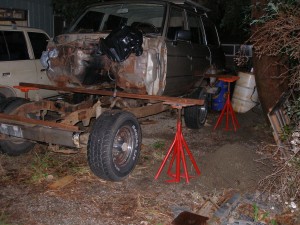 Time and road salt eventually take their toll on our wagons resulting in the dreaded body or frame swap. But other than lots of bolts, wires and fuel lines it’s really not that hard to do. The main concern is to be safe as you will have a lot of metal up in the air and a chassis rolling around to add to the fun.
Frames and Crossmembers
By Tony K
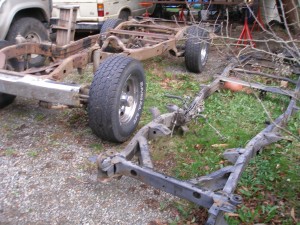 Essentially there were two frames used under our wagons, early (up to 84) and late (85 on). They were pretty much identical with the exception of how engines, trannies and other components were mounted. But late (88-90) model frames did get an additional crossmember layer at the rear which adds some strength. But do remember that no matter what engine and tranny combo was installed, any year body of the 60 Series will bolt to any year frame, all the body mounts are in the same location. My 82 BJ actually sits on an 89 FJ62 frame.
Understanding Crawl Ratios
 By Tony K
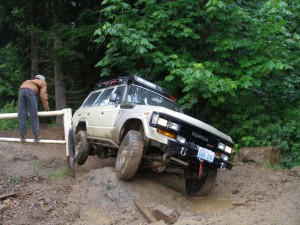
You may hear a lot about having a really low crawl ratio and while this sounds great there is more to it than just numbers. So just how do you determine the crawl ratio in your rig, multiply 1st gear x low range x diff gears. This gives you a crawl or final drive ratio. And what exactly does this mean? It will tell you how slow or fast you can go at a given engine rpm. You can do the math yourself or use the gear ratio calculator here on the website, it can be a lot of fun to mess with but be careful as some of the numbers are incorrect, but it will get you close.
Drivetrain Info
 By Tony K
–Engines–
2F
4.2L inline 6 cylinder gas
165 HP at 3600 rpm
210 Ft lbs of torque at 1800 rpm
3FE
4.0L EFI in line 6 cylinder gas, (sold in Japan with a carb as the 3F)
155 HP at 4000 rpm
220 ft lbs of torque at 3000 rpm
3B
3.4L in line 4 cylinder diesel, indirect injection (pre-combustion design)
98 HP at 3500 rpm
159 ft lbs of torque at 2200 rpm
Transfer Case Compatability
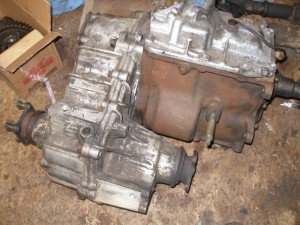 There were several variations of split t-cases available in our wagons over the ten years they were made. Some of these differences were important, others not so much. The most important one is determining whether a particular case will fit in your rig. And this in turn is determined by what tranny is in your rig. Because Toyota not only used more than one t-case variation they also used different configurations of the same tranny. Also worth mentioning is that there is no difference between the t-case for a diesel and the one for a gas rig. Same splitcase used for both.